


Glory in Assisi
January 07 2026
|
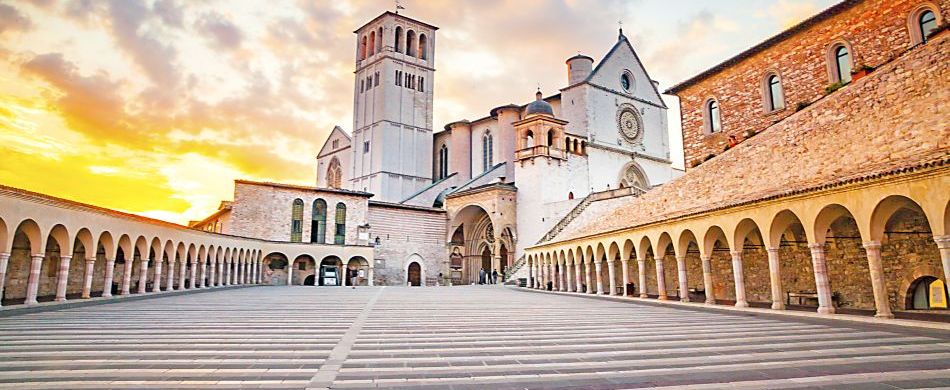
The Basilica of St. Francis in Assisi - © Adobe Stock
FOR MORE than 600 years, pilgrims visiting the tomb of St. Francis in Assisi would gaze above the altar and see an image of Francis in Glory. The iconic Franciscan three knotted cord falls down the length of his glorified religious habit, which is no longer simple and poor, but magnificent in splendor. For Francis is in heaven and calls to us that we might grasp his cord and be pulled ever closer to the Lord through our living a life of poverty, chastity, and obedience.
In 1818, the friars dug under the altar, looking for the tomb of Francis that had been resting in silence for hundreds of years. Finding it, they then constructed a small tomb chapel in which visiting pilgrims for the past 200 years have been able to sit and quietly speak to God and Francis in quiet, meditative prayer.
In 1978 Francis’ mortal remains were examined and confirmed by a commission of scholars appointed by Pope Paul IV; they were then placed in a glass urn in the ancient stone tomb.
This year, from February 22 to March 22 the Saint’s body will be publicly displayed for the first time ever, inviting pilgrims to renew their faith and rediscover his living legacy. His bones will be relocated to the foot of the altar in the Lower Basilica, under the watchful gaze of Francis in Glory. Countless pilgrims coming to Assisi for the veneration of Francis will approach the altar and look down to see his bones on display. Wise pilgrims will also look up at the image of Francis in Glory and take to heart the words in the arch below:
Now Francis renews the Gospel way of life,
and opens for all the path that leads to heavenly salvation.
In restoring holy Poverty,
he mirrors the chastity of the angels;
through obedience, he joins himself to the divine Trinity.
Adorned with these virtues, he ascends to reign,
and, enriched by these fruits, he proceeds in peace,
joining the ranks of the angels
and going forth to Christ.
Let each of his brothers (and sisters)
follow the pattern he has handed on.
Inspired by Francis, we are encouraged to follow the pattern he handed on and renew the Gospel life in our times. To help us do this during the 800th anniversary of the Easter of Francis, we turn to two Popes, both named Leo.
Two Leos - One Gospel
When Pope Leo XIII wrote his 1882 encyclical Auspicato Concessum to mark the seven-hundredth anniversary of the birth of St. Francis of Assisi, he looked upon a world changing faster than anyone could comprehend. Industrial cities were growing rapidly as human labor was being exploited. The Pope saw a society where “charity has grown cold” as faith disappeared into the margins of public life. His remedy was not a new program or decree, but the rediscovery of a way of life inspired by Francis.
Leo XIII proposed a simple way forward by inviting ordinary Christians to take up the Franciscan pattern of Gospel living. By joining the Third Order of St Francis, lay people would learn to sanctify the world from within by turning their homes, workshops, marketplaces, and parishes into places where the Gospel was not just preached, but lived and breathed. The Pope called this movement “a school of Christian perfection for those living in the world.” To join it was to turn ordinary life into a sanctuary, rebuilding human fraternity bit by bit through mercy, simplicity, and joy (Auspicato Concessum, § 4).
What Leo XIII saw in the industrial age, we find today in our digital age. One hundred and forty years later, Pope Leo XIV, in his 2025 exhortation Dilexi te, considers another anxious, distracted world and discovers the same wound that continues to fester as compassion is mocked, poverty is ignored, and mercy is casually reduced to sentiment. Some people even “dismiss or ridicule charitable works,” as though care for the poor were a relic of the past. “This convinces me,” he writes, “of the need to go back and re-read the Gospel, lest we risk replacing it with the wisdom of this world” (Dilexi te, § 37).
The echo between the two Leos is unmistakable. Each speaks into a time when Christianity risks becoming an abstraction, when religion is discussed and manipulated rather than lived and embodied for the common good and salvation of all. So, both Leos turn to Francis as the antidote, as a living language of the Gospel that teaches us how to walk as disciples.
Francis himself said it in simple words, “No one showed me what I ought to do, but the Most High Himself revealed to me that I should live according to the form of the holy Gospel” (Vita Prima, 22). This revelation of Francis shaped his whole life, and through him, the consciences of both Church and society were formed. For in Francis, the Gospel becomes the breath of life.
Leo XIII concretized Francis’ revelation into action. He gave the world a framework for living it publicly, as men and women who would embody the Beatitudes in the midst of ordinary life, carrying peace and justice into factories and city streets. Leo XIV is now interiorizing it by calling for a universal renewal of heart. In Dilexi te we sense how all Christians are Franciscan-hearted when they read the Gospel with the poor as its commentary. In this way “the poorest are not only objects of our compassion, but teachers of the Gospel” (Dilexi te, § 79).
Together, the two popes form a Franciscan duo of renewal.
- Leo XIII looked outward: rebuilding charity and ensuring justice through concrete works and fraternity.
- Leo XIV looks inward: rebuilding faith through conversion of perception, through seeing Christ again in the faces of the excluded.
Both insist that the Gospel life is not an escape from the world, but its transfiguration.
The table of mercy
In one of the most pastoral moments of Dilexi te, Leo XIV observes that the same divisions tearing nations apart often dwell silently within our families. “If Christians wish to bring Christ back into the public square,” he writes, “they must first let him dwell again at their own tables, where differences are healed not by victory, but by mercy.” He warns that polarization (political, cultural, and even ecclesial) begins when we cease to look upon one another with the eyes of Christ.
Here the Franciscan pattern of life becomes personal. The peace of Assisi was never abstract diplomacy. It was born of reconciliation between brothers and sisters who had quarreled as forgiveness was spoken face to face. To live the Gospel in polarized times means beginning a “peace-rebuilding” at home by turning mealtime into genuine conversation, replacing contempt with curiosity, choosing listening over winning, and becoming civil in our discourse.
Grammar of truth
Francis called every creature “brother” or “sister” because he had first allowed God to heal the brokenness of his own heart. When we do the same, when we let Gospel gentleness replace the clenched fist of argument, we participate in what Leo XIV calls “the rebuilding of communion in miniature.” The Church, he contends, must become again a family that heals families, a community where mercy is the grammar of truth.
Imagine how different our world could look if our households, parishes, and communities took up this small Franciscan pattern of life by speaking kindly in a harsh age, forgiving before being asked, and seeing difference not as threat, but as invitation. This is how the Gospel, re-read and re-lived, can heal the wounds of our time through a poverty that sees all as a gift from God to be shared, a chastity that offers the preferential option for the poor, and an obedience that listens twice before speaking.
Unique Exposition
As the bones of St. Francis will be placed in the light for the 800th anniversary of his Easter, perhaps the deeper miracle will be that the heavenly light of Francis in Glory will take hold of us. For what we honor in him is not distant or past, but the very nearness of Christ still shining through a humble man who learned to love without measure. If we let that light shine in our own hearts, then the Easter of Francis becomes ours as a rising of gentleness overcomes fear, as communion dispels division, and as praise replaces complaint. Following in Francis’ pattern of life, and encouraged by the two Leos, may we walk in a renewed simplicity of that iconic Franciscan cord. Through our example, may the world glimpse again the joy of the Gospel as a breath of fresh air that lifts hearts toward heaven, heals creation, and rekindles hope in the ordinary holiness of daily life.
Updated on January 07 2026