

God & I: Anselm Grün, OSB
July 01 2026
|
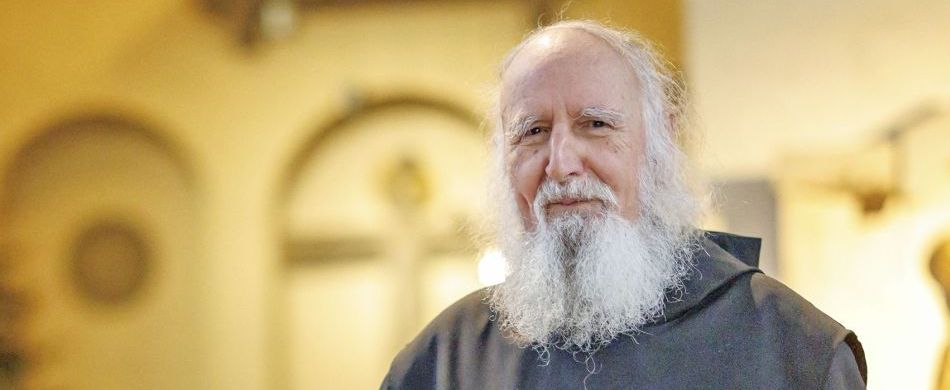
Father Anselm Grün believes it is important to see that in every person, despite all their wounds, the ‘divine child’ still lives; © picture alliance – Getty Images
FATHER Anselm, what role did faith play in your family as a child?
I grew up in a very religious family. Three of my father’s siblings were Benedictines – one monk and two nuns – and they lived very close to the church. So I became an altar server at an early age. My parents went to church every day, and faith was something completely natural for us.
When did you first feel the desire to dedicate your life to God?
At the age of 10, during my First Communion, I was deeply moved by the experience. It was then that I first spoke with my father about the prospect of becoming a priest. He was enthusiastic and asked whether I wanted to become a diocesan or a religious priest. Since his brother was a Benedictine, he contacted him, and that is how I soon ended up entering a Benedictine boarding school.
From that moment on, the thought of becoming a priest remained alive within me. During adolescence, there were naturally crises and periods of questioning and doubt, but I faced those crises consciously.
In the early 1970s, many of my confreres left, and I, too, had to ask myself: Why am I staying? This was during the renewal in the Church in the wake of Vatican II, and I continued feeling a deep desire to proclaim the message of Jesus in a way that would truly inspire people. Whenever I considered leaving, I sensed very clearly that this option was not the right path for me.
You often bring together spirituality and psychology. Why is this dialogue so important today?
Psychology has helped me understand faith in a way that is healing, so that it has a therapeutic dimension. Also, people nowadays do not simply want to believe, they also want to experience what they believe, and psychology can help make this experiential dimension of faith accessible and understandable.
In your books you write about the need to find an “inner space.” How can we realize this in our hectic daily lives?
We need to create a sacred space in the depth of our soul – a place where we are free from the expectations of others, where we are whole and at peace, untouched by life’s wounds. There, I am completely myself, free from the pressure to prove or justify myself.
I served as cellarer – the financial administrator of a monastery – for 36 years, and attended many meetings. At first, I found them burdensome. But then I learned to engage fully in the conversations and problems, while not allowing them to enter this inner space.
I also give many workshops, including for participants working in very secular fields. At the end, many say that the idea of this inner space touched them most deeply. They sense how much they need a place, even in the midst of busyness, where they are not dominated by external problems, restlessness, and pressure.
What does living simply mean?
Living simply first of all means being fully present in the moment – engaging completely in what I am doing, without ulterior motives, without the pressure to impress others or prove myself. It means simply being there.
Secondly, it means living modestly, without luxury, and being content with simple things. This does not mean rejecting life but living consciously – without constantly comparing oneself to others or feeling the need to have as much as they do.
Who is God for you?
My image of God has changed over the course of my life. As a young person, God was above all the one who challenged me to live ascetically, to exercise self-discipline, and to eliminate my faults.
I now experience God differently. For me, God is a “You,” a mystery I can address. Someone who encounters me in the Bible, through which I sense that He speaks to me. At the same time, God is also beyond the personal for me – He is both personal and transpersonal.
God is the love that permeates everything; He is beauty, energy and strength. Above all, God is truth and freedom. I can hide nothing from God; I can show myself to Him as I am, with all my depths and shadows. At the same time, I experience a profound freedom in Him: everything is allowed to be because God can transform everything within me.
As a spiritual guide, what have you learned most about human beings?
That I must not judge or condemn anyone. The most important thing is to try to understand a person – even if they have made mistakes or done evil. What matters most to me is the question: Why has this person become the way they are? What is their background?
In accompanying others, I naturally also encounter the darker depths of their soul: how profoundly people can be shaped by fear and helplessness. This is why it has become especially important for me to help them find trust again.
What is the most common form of suffering you observe today?
In many today I see fear above all – the fear of not being able to cope with life, fear of the future, and depressive moods. Added to this are experiences of helplessness, meaninglessness, and loneliness; some people also grapple with feelings of failure.
At the same time, it is important to see that in every person, despite all these wounds, the ‘divine child’ still lives. This is an image for the healing forces of the soul. I always try to address these forces in people and encourage them to place their trust in these forces.
What is your message for those who are searching for God but cannot find Him?
I paraphrase Saint-Exupéry to them: In the longing for love, there is already love. In the longing for faith, there is already faith. And in the longing for God, something of God is already present. So I tell them, “You may not be able to feel God, but if it hurts you not to feel Him, then there is already a longing for Him within you. And in this longing for God, something of God Himself is already present within you.”
Can you share an example of someone who experienced conversions through your apostolate?
When I lead leadership seminars, I often conclude them with a Eucharistic celebration. Once, a man who had not been in church for twenty years told me that he had been so deeply moved by it that he started going to church regularly again.
Another experience concerns a woman with an aggressive brain tumor. The doctors had given her only a few weeks to live. She asked me for a small blessed cross, which she held in her hand all night. She then lived with this illness for four and a half years. Whether one would call this a miracle is difficult to say – but her faith apparently helped her to hold on to Christ. In the end, however, she did pass away.
In a time marked by fear and aggression, even in social media, how can we preserve peace of heart?
This aggression in social media and society is palpable. What matters is not to give it power over us, but to gain inner distance and critical detachment from it. Ultimately, we are dealing with the problems of individuals who express this aggression, so we should be careful not to absorb it.
It is also important for us not to lose faith – alongside these aggressive voices there are also many good people who try to live out Christian and human values; in them lies our hope of a better future.
You have written almost three hundred books. Is writing a spiritual path for you?
Yes, through writing, many thoughts become clearer to me. I always write with human beings in mind whom I can picture before me, and to whom I want to make the faith understandable and offer encouragement. Writing keeps me alert and brings me into relationships with people, because I imagine their questions in a very concrete way.
Sometimes I cannot find a suitable answer while talking with people, but if I write it becomes easier for me to express what I truly want to say; to express what sustains me, and what can help others find new support and hope in their faith.
What does Saint Anthony mean to you?
Saint Anthony was a wonderful preacher who spoke very simply and yet was able to touch men and women deeply – so he is a great role model for me. In Germany, he is often invoked when one wants to find something that has been lost; a fellow brother of mine swears by it, saying he always finds what he is looking for through the intercession of the Saint of Padua.
BORN ON January 14, 1945, in Junkershausen in Franconia, Anselm Grün grew up in Munich. After completing his secondary education, he entered the Benedictine Abbey of Münsterschwarzach near Würzburg at the age of 19. There, drawing on the Rule of Benedict of Nursia, he learned the art of guiding people and, already in the 1970s, rediscovered the tradition of the early Desert Fathers, whose significance he sees particularly in connection with modern psychology.
After studying philosophy, theology, and business administration, Grün became Cellarer (economic director) of Münsterschwarzach Abbey in 1977, and for 36 years he oversaw the financial administration of the monastery, and was also responsible for about 300 employees in more than 20 enterprises.
In courses and lectures, Grün addresses people’s concerns and questions. In this way, he has become a spiritual advisor and companion for many leaders. With around 300 books, translated into 30 languages, Grün has sold 20 million copies worldwide to date.
Updated on July 01 2026