God & I: Dr. Carmina Chapp
May 04 2026
|
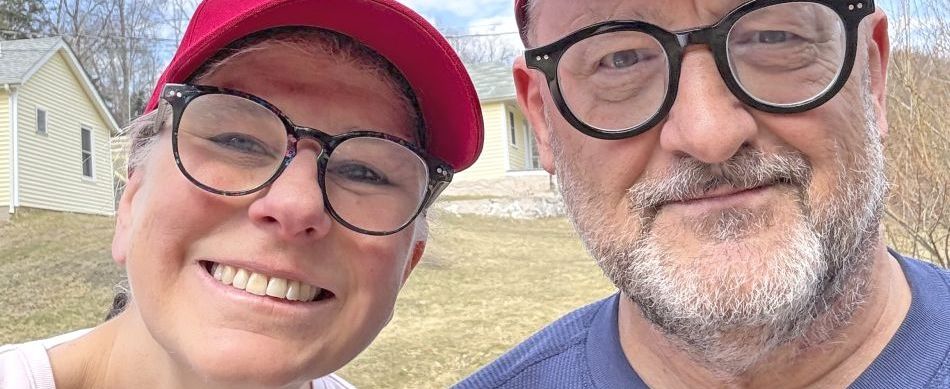
With theologian husband Larry Chapp; the couple are Oblates of St. Benedict
WHAT role did faith play in your family while you were growing up?
I’m a cradle Catholic, and grew up in a family that actively practiced the faith by regularly attending Mass. I’m the fourth of five children – four girls and one boy.
Both of my parents were from New York City and grew up during the 1950s, a time when there was a vibrant Catholic culture there. Even after moving out of the city, they brought that rich tradition with them. We attended Catholic schools, participated in the sacraments, and prayed at home.
Your journey includes a conversion experience during your studies in Rome. What happened during that time that reshaped your faith and vocation?
That time in Rome was incredibly significant for me. I was studying English literature at the University of Notre Dame and had also taken Italian because my mother is Italian. Eventually, I became a double major. In 1988, I did a study abroad semester in Rome, which happened to be during the Marian Year declared by Pope John Paul II.
Providentially, my 6th-grade teacher, a Felician nun from a Polish order, was stationed in Rome at the time. She was able to get me tickets to various papal audiences and other events at the Vatican. It was a powerful encounter with the universal Church. Coming from a small town in New Jersey, this immersion in a global Catholic experience was eye-opening. I was struck by the different languages and cultures all united in the same faith.
While in Rome, I began to pray more, attend daily Mass, and even learned the entire Mass in Italian. I started praying the Rosary as well.
One day in May, near the end of the semester, I was at daily Mass in Sant’Andrea della Valle on Corso Vittorio Emanuele. I was feeling deeply homesick, praying and on the verge of tears. Suddenly, I felt someone come up behind me and gently hug me, as if to say, “It’s okay.” I assumed it was a classmate, but when I turned around, the church was completely empty.
It was a mystical moment. As I left, I passed a side altar with a painting of the Sacred Heart of Jesus in the San Sebastiano Chapel. My eyes kept being drawn to the image, and I had this deep realization: It was you. I knew, with absolute certainty, that Jesus was truly present with me, resurrected and real. It was my personal, Pauline experience.
That moment transformed everything. I shifted my academic path from English and Italian to Theology. It marked the beginning of my vocation.
And what happened between your childhood faith and that conversion?
That period was mostly high school and college. Even then, I never really struggled with faith. It felt natural to practice it. I didn’t experience peer pressure to stop going to church, and at Notre Dame there was Mass in every dorm. For a time, I even served as the liturgical commissioner for my dorm.
In Rome, I felt an interior prompting to pray more. I remembered how my mother prayed the Rosary every night, so I began doing the same. The Rosary became my anchor, and through those months of prayer I was led to that powerful experience in May.
Who is God for you?
God is everything to me. He is the one who loves me unconditionally and with immense mercy, even when I fall short. That love inspires me to love in return: my family, my coworkers, everyone around me.
God is with me in every moment, and I’ve come to realize that His plans are always better than mine. Looking back, I can see how following His will – especially when it differed from what I wanted – always brought more joy and peace than I could have imagined.
I’ve reached a point where I can say, “Whatever your will is, Lord – I want that.” Whether that means living in a castle or on the streets, I want only what will glorify Him.
You and your husband, Larry Chapp, are both theologians. How has this fact shaped your marriage and mission?
It’s been a gift. We can talk theology at the breakfast table. We bounce ideas off each other, challenge each other, grow together intellectually and spiritually.
When we discerned founding the Catholic Worker farm in northeastern Pennsylvania, it was through prayer as a couple. Our shared theological grounding gave us a common mission; that unity is rare and precious.
We also even disagree at times, but that’s part of the joy. This refines our thinking, but privately, in the safety of our home, before our ideas go public.
How did the worlds of academic theology and the Catholic Worker farm meet and challenge each other?
They met beautifully, making our Theology became incarnational. My husband and I discerned the call to the Catholic Worker farm through prayer. There we saw theology come to life: what we taught in classrooms found tangible expression in our daily work.
Living in a rural setting deepened our understanding of biblical imagery – sheep, seeds, harvests – those metaphors became real. We experienced how God’s creation reflects His ways.
Hospitality was also central to our ministry. We welcomed people to the farm, worked alongside them, and tried to love them as God loves – so they could experience His unconditional love.
What aspect of Dorothy Day’s spirituality is most relevant for the Church today?
Dorothy Day is a saint for our time. Today, we often see a disconnect between liturgy and life. There’s activism without sacramental grounding. When that happens, even good works can be driven by ego, politics, or personal ambition.
Dorothy Day’s entire mission flowed from her sacramental life. As a convert, she deeply appreciated God’s mercy. Her love for the poor came from that experience of being loved by God.
As Dean of the School of Theology, what kind of formation do Catholics most urgently need today?
We need formation that equips people to integrate their faith into the secular world. It’s not enough to go to church and be good at home. We have to bring faith into healthcare, business, education, technology, in every field.
Too often, people compartmentalize their faith. We need to be leaven in the world. That requires strong theological formation and the courage to live out our faith wherever we are.
I see a powerful revival among young people. Here in the US, events like the National Eucharistic Congress and the SEEK conference draw thousands of college students who are genuinely seeking Christ. They’re discovering the rock of truth in Jesus. That gives me great hope.
You’ve spoken about the risks of being spiritual but not religious. What is lost when faith is separated from ritual, doctrine, and community?
What’s lost is the anchor – trust in a dependable, objective God.
Without ritual or doctrine, spirituality can become subjective. It can change with our moods, our desires, and eventually, it becomes self-centered. We start to create a god in our own image.
Religion, through ritual, doctrine, and community, grounds us in objective truth. It forms us, holds us accountable, and connects us to God and each other. Ritual keeps us rooted. Doctrine gives us a clear path. Community supports and challenges us. All three help us grow toward true holiness.
How can we help people rediscover the depth of Catholic liturgy today?
First, we need to not just explain what we do during the liturgy, but why we do it. Second, we need to witness to how liturgy shapes our lives. When people ask, “How do you stay so calm in a crisis?” we should be able to say, “Because I go to daily Mass.”
We need to rediscover and communicate the power of sacramental grace; that it’s not just symbolic, but real, transformative.
Without that connection, people may see Church teachings as rules without help, but the sacraments give us the grace, especially through the Eucharist, to do what we’re called to do.
Do you have a special connection to St. Anthony of Padua?
Absolutely. During that semester in Rome, I visited Padua, and I had a very powerful experience at his Tomb.
Interestingly, I was supposed to be named Anthony Michael, after my grandfather, who was born on St. Anthony’s feast day. But I was a girl, so I was named after my grandmother instead. Still, St. Anthony stuck with me. I pray to him every day for a specific intention.
What role do the saints play in your life?
The saints show us that it’s possible to live the Christian life. I often tell people starting their faith journey, “read the lives of the saints.”
I feel particularly close to St. Catherine of Siena because of her obedience to God’s will, her boldness and her humility.
And what role does the Virgin Mary play in your life?
Mary is both my model and my help. She led me to Christ through the Rosary when I was a student in Rome. She’s not only an example of holiness, but also a mother who walks with me, supports me, and helps me fulfill my mission.
DEAN of the School of Theological Studies and Associate Professor of Systematic Theology at Saint Charles Borromeo Seminary in Pennsylvania, Dr. Carmina Chapp holds degrees from the University of Notre Dame, Providence College, and Duquesne University, where she earned a Ph.D. in Roman Catholic systematic theology. A longtime educator and leader in seminary formation, she has served in Catholic higher education for more than three decades. Dr. Chapp and her husband, theologian Larry Chapp, are Oblates of St. Benedict. They founded the Dorothy Day Catholic Worker Farm in northeastern Pennsylvania, and currently live in the Scranton area, where they continue their Catholic Worker ministry.
Updated on May 04 2026