
God & I: Ilia Delio, OSF
October 05 2026
|
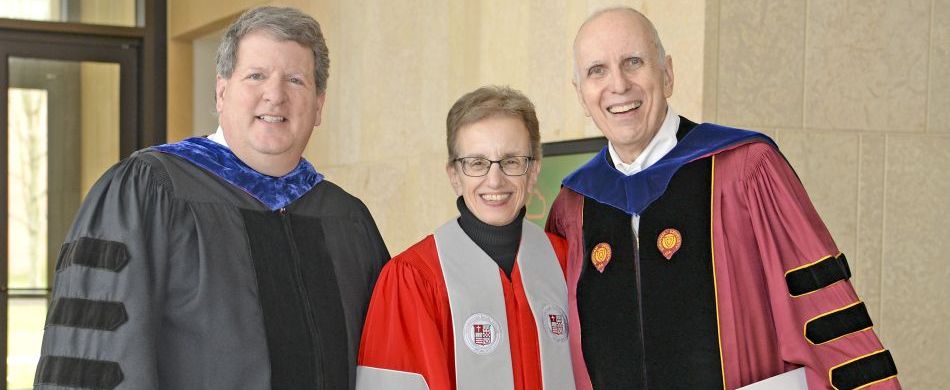
Receiving an honorary degree at Sacred Heart University between a Faculty Member, left, and Fr. Anthony Ciorra, Professor at Sacred Heart, February 5, 2020 - Photo by Tracy Deer-Mirek – Flickr.com
WHAT is your earliest memory of God, and how has your image of Him changed over the years?
I grew up in an Italian-American family where religion was an important part of our culture. I attended Catholic school, and my early image of God was that of a loving Father: a personal presence who cared for me and watched over me.
Over time, however, that understanding changed. Through St. Francis I discovered a vision of God not as distant and above us, but present in every creature and person. This was a turning point for me. St. Bonaventure then helped me see God as an overflowing fountain of love.
Who is God for you personally?
Today, I no longer see God simply as a father figure above me, but as the power of love within me and within all things: from a God above us to God dwelling within us. God is love. God is that deep, personal, and ultimately ungraspable mystery of love that is always present, even in those moments when we may feel distant from God. God is the eternal and inexhaustible source of love itself. Francis experienced this overflowing love within himself. In his Letter to the Faithful he speaks of God “descending” from on High and is humbly present with us. His Canticle of Creatures begins his song with “Most High” and ends with humility. For Francis, God is the Most High who bends low and embraces us in love.
As we celebrate the 800th anniversary of St. Francis’ death, what is the greatest misunderstanding people have about him?
I think we often oversimplify Francis. He was not merely the joyful, carefree saint of popular imagination, but a person of profound depth, shaped by suffering, conversion, and a lifelong search for God.
Francis was not simply a “birdbath figure” for our gardens. His joy came from a deep transformation in love and a single-hearted devotion to Christ. In a world marked by war and suffering, he focused on the one reality that mattered most: the incomprehensible love of God calling us to become that love in the world.
What does Francis’ example of poverty mean today, especially in a consumer society?
Francis’s poverty was not simply about having fewer possessions. He understood poverty as sine proprio – living without possessing. The issue is not ownership itself, but the way possessions can become tied to our identity and our desire for power.
Consumerism tells us that what we own defines who we are. Francis challenged this by showing that true poverty means letting go of the need to place ourselves above others and recognizing that we belong to one another as brothers and sisters.
Franciscan poverty is therefore not simply about giving things away, but about learning to live in freedom and openness.
If Francis walked through our cities today, what would make him sad and what would give him hope?
I think Francis would be saddened by the great inequalities in our cities: for example, the contrast between extreme wealth and poverty. Such divisions show that we are not truly living as one human family.
He would also be concerned by consumerism and the speed of modern life, which often prevent us from being attentive to one another and to creation. Francis would invite us to slow down and rediscover God’s presence within us and around us.
At the same time, he would find hope in the growing desire for community and spirituality, and in the search for a more meaningful way of living.
St. Anthony was one of the first followers of St. Francis. Beyond being the saint people pray to when they lose something, what is his greatest message for Christians today?
I have always appreciated the advice Francis gave to Anthony: he encouraged him to teach theology, but only if study did not extinguish the spirit of prayer and devotion.
That wisdom remains important today. Theology must not become merely an intellectual exercise, but a path toward holiness and transformation.
St. Anthony was a great theologian and preacher because he could communicate profound truths in a way ordinary people understood. He made faith concrete and accessible. This remains a powerful lesson for preaching today: the Word of God must not remain abstract but must touch lives and transform hearts.
You often write about science, evolution, and faith. Do you think Francis saw the world in a way that was ahead of his time?
Yes. Franciscan spirituality has much to offer our world today. Francis did not see creation as dead matter to be manipulated, but as a living reality filled with God’s presence. He lived as a brother among all creatures, recognizing the deep interdependence that Pope Francis later highlighted in Laudato Sì. In this sense, Franciscan spirituality resonates strongly with modern science.
Francis’ own life was an evolutionary journey: from a young man seeking worldly pleasures to a person transformed by love. I believe he would have felt very much at home in an evolutionary universe.
You have spent your life bringing together science and faith. What has each taught you about God?
The Franciscan tradition has always recognized creation as a place where God is revealed. Franciscans were among the early pioneers of scientific thought because they approached nature not as something lifeless, but as a manifestation of God’s presence.
Science helps us understand how the natural world works, revealing its complexity and beauty. But it cannot fully explain meaning, purpose, or why we are here. Those are questions addressed by faith and theology. Einstein said, “Science without religion is lame, religion without science is blind.” We need both perspectives if we are to appreciate the full mystery and beauty of our world.
Over the years, I have come to see science and faith not as competing ways of knowing, but as complementary paths toward truth.
Franciscan theology reminds us that love lies at the heart of reality. Scientists are driven not only by knowledge but also by wonder, curiosity, and the desire to understand. Ultimately, both science and theology point toward a reality of love that unites, sustains, and gives meaning to creation.
What do you think St. Francis would say to us about Artificial Intelligence?
I think Francis would approach artificial intelligence with both caution and curiosity. He would be concerned that we are becoming absorbed in artificial environments and losing our connection with the natural world and with one another.
He would also ask whether technology is deepening our relationships or replacing them. The challenge is to use AI in a way that strengthens our humanity rather than separate us from it.
For Francis, life was rooted in relationship: with God, with others, and with creation. The question is whether AI can help us become more connected, compassionate, and capable of living as brothers and sisters.
Looking back on your journey from scientist to Franciscan religious life, when have you felt closest to God?
I wanted to become a religious sister from the age of 3, so God has always been at the center of my life. Yet, surprisingly, one of the places where I encountered God most deeply was in the laboratory.
I remember looking through a microscope at a single cell magnified more than 300,000 times. What was invisible to the naked eye became a living world filled with extraordinary activity and beauty. I was overwhelmed by the mystery of life. At that moment, I realized that life was more than chemistry and biology. There was a deeper mystery – a mystery of love – that I could only name as God.
Science reveals the incredible unity and interconnectedness of creation. When astronauts look back at Earth from space, they see one small planet, one shared home. Francis understood that unity in a profound way.
Our challenge today is to rediscover that oneness. Knowledge should never be an end in itself. Knowledge that does not lead to love can become a source of power and division. True wisdom leads us toward greater communion.
If St. Francis were sitting with us today, what question do you think he would ask you, and how would you answer?
Perhaps Francis would ask why I chose this particular path in Franciscan life and felt called to return to something closer to his original vision.
He might also ask about my relationship with the Church. I would tell him that Christianity has much to offer the modern world. It is not outdated; rather, we are still discovering its depth and vitality.
With thinkers such as Teilhard de Chardin, I have come to see Christianity as deeply connected with the unfolding story of creation and evolution. Faith is not something static, but a living relationship with God’s love, continually at work in the world. That is why I believe the Church should remain open to new perspectives while remaining deeply rooted in the richness of its tradition.
If Francis asked what continues to guide my life, I would answer, “Everything is connected.” I hope he would smile – and remind me that every true connection begins in love.
FRANCISCAN sister, theologian, and author, Ilia Delio’s work explores the relationship between science, evolution, and Christian spirituality. She held the Connelly Chair in Theology at Villanova University until May 2026 and is currently Executive Director of the World Institute for Science, Religion and Culture in Washington, DC, dedicated to the integration of Science, Religion and Culture. She holds doctorates in pharmacology and theology and is widely recognized for her contributions to the dialogue between faith and contemporary scientific thought. The author of numerous books, including The Unbearable Wholeness of Being and Franciscan Prayer, Sister Ilia draws deeply from the Franciscan tradition, emphasizing creation as a dynamic expression of God’s love and inviting new ways of understanding faith in an evolving universe.
Updated on September 29 2026