God & I: John Pontifex
April 07 2026
|
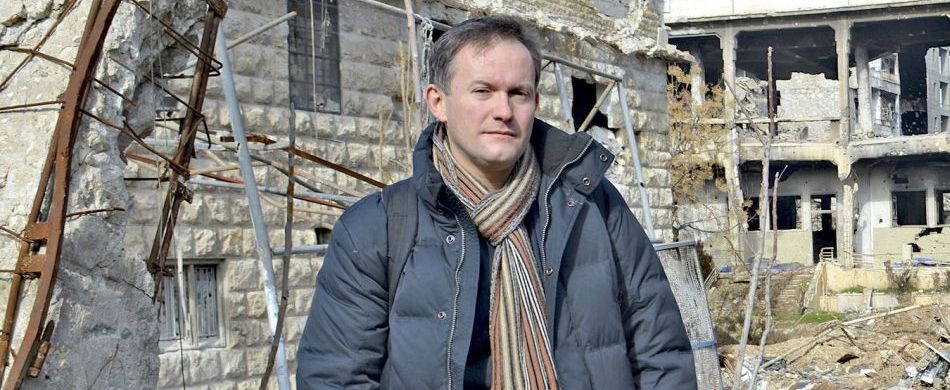
John in Aleppo, Syria, at the height of the civil war - Photo © Fr. Andrzej Halemba
CAN YOU tell us something about your religious upbringing?
I was raised by a deeply Catholic father and a Church of England mother. My father ensured that my four sisters and I practiced the faith. Four of his uncles were Benedictine monks of Downside Abbey; one, a ‘Martyr of Charity,’ died at Dunkirk in May 1940 after giving up his place on a rescue ship.
One uncle was still alive when I attended Downside, a Benedictine school. Faithful to his vows since joining the monastery at 18, his lifelong commitment deeply impressed me.
He was an intellectual, while my father, a former army officer, lived his faith in a practical way. Seeing how the same faith inspired both a scholar and a man of action shaped my sense of vocation.
At prep school most teachers were Protestant and sometimes asked me about my Catholicism, which made me feel “different” in a positive way. Though I considered the priesthood as a young adult, I have always felt called by the Lord to live my faith in whatever circumstances come my way.
Was there a moment when faith became something you consciously chose?
Yes. I remember a particular moment in childhood at a school sports day – something I never enjoyed – when I began asking deeper questions about what truly mattered to me. I was a fairly serious child.
Walking along a path that day, I reflected on the role of faith in my life and realized it was deeply personal and central to who I was – something I wanted to embrace consciously.
Around that time our parish curate asked me to become an altar server, a role I have continued in various forms ever since. It felt like a decisive moment: “This is who I am, and this is why it matters.”
That conviction was later reinforced through my work with Aid to the Church in Need, where I met people willing to risk their lives for their faith. Their witness continues to inspire in me a desire to remain faithful even in hard times.
You are Head of Press and Public Affairs at Aid to the Church in Need (UK). Where have you most clearly sensed God’s presence amid persecution?
In 2004, I travelled to Sudan with Aid to the Church in Need. Owing to a visa delay, I travelled alone and arrived at Khartoum airport in the middle of the night. It was intensely hot, I had never been to Africa before, and I felt frightened.
The following morning, we drove from central Khartoum to the outskirts, where a vast tent city had sprung up. Tens of thousands of people were living under tarpaulins – many of them Christians who had fled violence in the south.
We visited a makeshift structure being used as a church. A bulldozer had been sent to demolish it, but the people had gathered inside to prevent its destruction.
There I met a displaced woman named Michelle and her two small children. Holding a beaker of water, she said to me, “I would rather live my faith and remain true to what I believe than drink water and live a lie.”
In that searing heat, deprived of even basic necessities, she chose faithfulness at immense personal cost, and I sensed that God was present in her, sustaining her.
Have there been moments when you struggled to reconcile faith in a loving God with the cruelty you witnessed?
I have visited places marked by pogroms, ISIS violence, endemic poverty, and disease, where innocent people suffer repeatedly. It is understandable that some who encounter such suffering lose faith; it is not for me to judge them.
One particularly harrowing experience was visiting northern India in late 2008 in what is now Odisha. Following attacks in Christmas 2007 and in the summer of 2008, more than 400 churches were destroyed, 6,500 homes burned, and tens of thousands of people displaced. Priests were attacked, churches were set on fire, and the smell of burning still lingered when we arrived.
After returning to London, I went to Westminster Cathedral to pray. Kneeling before the Blessed Sacrament, I was overwhelmed and burst into tears, acutely aware of the immense injustice inflicted on innocent people.
What has the courage of persecuted Christians taught you about trusting in God?
About a year ago, I met Tobias, a catechist in Sokoto, north-west Nigeria. Intruders attacked and stabbed him, but he fought back until neighbors intervened. Tobias nearly died and spent time in intensive care. In court his attacker stated that he had been targeted because of his faith. He was angry that Tobias was a faithful and proactive catechist.
Later, Tobias and his wife prayed about whether he should continue serving as a catechist, given the danger and their responsibility toward their four children. They decided to persevere, witnessing to Christ with courage and humility.
This taught me that trusting God ultimately means trusting in His mercy. Even when everything else is stripped away, love and forgiveness endure, letting God’s light shine through us.
Nearly twenty years ago, you helped found Persecuted and Forgotten, Aid to the Church in Need’s global report on Christian persecution. How did this project begin?
The project began when a pre-existing research initiative fell into abeyance. The person responsible could no longer continue, and I agreed with the then National Director, Neville Kyrke-Smith, that I would take it on. I was largely working alone, so it was daunting.
That same year, I visited Pakistan and met a Christian man falsely accused of blasphemy and forced into hiding. His refusal to renounce his faith despite intense pressure convinced me these were stories the world needed to hear.
Persecuted and Forgotten? A Report on Christians oppressed for their Faith became a way to give voice to the voiceless – a bridge of solidarity between suffering communities and the wider Church. Though the work is demanding, involving careful verification and concern for safety, it remains central to our mission, and we are preparing another report this autumn.
In your advocacy for religious freedom, especially regarding Article 18 of the Universal Declaration of Human Rights, where do you find the strength to persevere?
The Catholic Church has a rich tradition of reflection on human dignity and freedom. Vatican II clarified the central importance of religious freedom – not just the right to share one’s faith, but also the right of others to accept or reject it according to conscience.
Article 18 recognizes freedom of thought, conscience, and religion, including the right to convert. Without this, freedom is hollow. Progress since 1948 has been slow, but the wisdom of Article 18, closely aligned with Church teaching, continues to urge us forward.
You have written about priests and religious serving in extreme conditions. Has their witness changed how you understand priesthood, sacrifice, and holiness?
One priest who profoundly influenced me was Father Andrew Helemba, a Polish priest with whom I travelled to Egypt, Pakistan, and Syria during the civil war. He embodied priesthood through humility, courage and deep prayer.
He insisted on celebrating Mass every morning before travelling; he never lost his temper, never complained, and willingly risked his life for others. He showed me that holiness can be lived faithfully, even amid danger and hardship.
Who is God for you?
For me, God is love. Love is the force behind creation and the heart of Christ’s life. Jesus never coerced; He invited. God fully respects human freedom, granting immense dignity to each person.
God does not remove suffering or take away the cross. Instead, He promises that love, mercy, and truth will ultimately prevail – if not in this life, then in the next – always pointing us toward eternal life.
Do you see storytelling as part of your vocation?
Very much so. Jesus Himself was one of history’s greatest storytellers, and Scripture is a living narrative of human struggle and divine love. At Aid to the Church in Need, we tell stories pastorally – through individual lives – because God speaks heart to heart.
Stories help people connect with suffering in a way statistics never can. Lived truth carries a power no abstract argument can match.
What can ordinary Catholics do to support persecuted Christians?
First, prayer – especially the Rosary. Many persecuted Christians ask for nothing more than our prayers. The power of the Rosary is evident in the experience of Bishop Oliver Dashe Doeme of Maiduguri, whose diocese, devastated by Boko Haram, was sustained and renewed through prayer.
Second, learn and act. Follow Aid to the Church in Need, engage with the stories, and support initiatives like the Article 18 petition. Solidarity begins with awareness and commitment, as religious freedom remains one of the defining challenges of our time.
Would you like to share an Easter message with our readers?
No matter how much we are suffering, Easter proclaims the truth that beyond the Cross is the light of the Resurrection. We should cleave to that hope as the deer yearns for running streams.
HEAD OF Press and Public Affairs for Aid to the Church in Need – UK (www.acnuk.org), John Pontifex was born in London in 1975. With over twenty years with ACN, John has travelled extensively to regions affected by conflict and persecution, including China, Cuba, Eritrea and Ethiopia, Sudan, Nigeria, India, Pakistan, Iraq and Syria.
Nearly two decades ago, John founded ACN’s flagship Persecuted and Forgotten report on global Christian persecution, published worldwide, and he has also served on the editorial committee of the Religious Freedom in the World Report, including several years as Editor-in-Chief.
John also leads major advocacy campaigns, including the global petition promoting full implementation of Article 18 of the Universal Declaration of Human Rights.
He is a regular contributor to Catholic media, appears on BBC programs, and was invested as a Knight of the Holy Sepulchre in 2023.
Updated on April 07 2026