



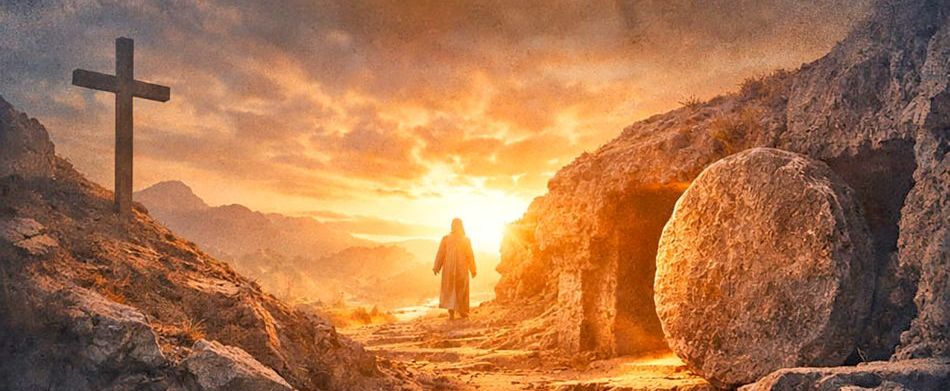
Christ lights a quiet fire in the darkness, the fire of spiritual love – AI Image
Dear Friend,
This April issue reaches you as Easter draws near. The feast of feasts – the Resurrection of Christ – reminds us that life is stronger than death, and that hope can return even when everything seems lost.
On pages 6 to 8, you will find an interview with John Pontifex of Aid to the Church in Need. His words lead us to places where believing in Christ can still mean facing fear, injustice, and violence – not distant or abstract realities, but concrete lives marked by courage, suffering, and fidelity.
Among the many stories I have recently read on this subject, one has particularly touched my heart. It comes from Nigeria, a country that many observers today describe as one of the most dangerous places in the world for Christians there, who live under the constant threat of attacks and persecution.
It is night when armed men arrive in a village. First, the sound of motorcycles in the distance. Then raised voices. Then gunfire. Lights go out. People run and hide where they can, seeking shelter behind walls too fragile to offer real protection. In that darkness, Ngozi is there as well, a mother holding her children close, barely daring to breathe.
When she hears footsteps approaching, she grips her husband’s arm and begs him to remain hidden. But he gently shakes his head. He does not want to flee. He wants to protect his family. He wants to speak – to explain that they are simple people, that they have done nothing wrong, that they are not enemies. He steps outside. Ngozi watches him disappear into the darkness, her heart racing. Then a gunshot. Voices fade away. Finally, silence – a silence heavy with a deeper fear: the fear of facing reality. Her husband is among those who will not return.
In the days that followed, when Ngozi was asked what she carried in her heart, she did not hide her tears, nor did she justify the violence she had endured. Yet she refused to let hatred have the last word. Her husband, she said, was with God. His life did not end that night, and for this reason she can even pray for those who took his life. Then she simply added, “My husband is now in the light.”
In this quiet statement, we glimpse the heart of Easter. It is not an easy victory, nor the removal of the cross, but a life that rises precisely where death seemed to have the final word. The Resurrection does not erase wounds, but it prevents them from becoming closed tombs. They remain, yet they no longer imprison us, because Christ is present within them.
We must be careful not to place our own struggles on the same level as Ngozi’s tragedy. Her suffering belongs to a depth of violence and loss that many of us will never know. And yet, without comparing or diminishing her pain, her story touches a place we all recognize: the experience of the night.
We do not need to live in a war-torn country to know moments when darkness enters our lives – through illness, broken relationships, loneliness, or hopes that quietly fade. The circumstances are not the same, but the night can feel just as real.
It is precisely there that Easter draws near. Not by removing the stone of suffering, but by rolling it back just enough to let light enter. When everything seems still, Christ lights a quiet fire in the darkness – the fire of God’s love – opening the way to a new beginning.
On behalf of all the friars of the Basilica of Saint Anthony in Padua, may the Risen Christ walk with you through your nights and lead you gently toward the light.
Peace and all good,
Updated on March 31 2026