


Called by Name
March 09 2026
|
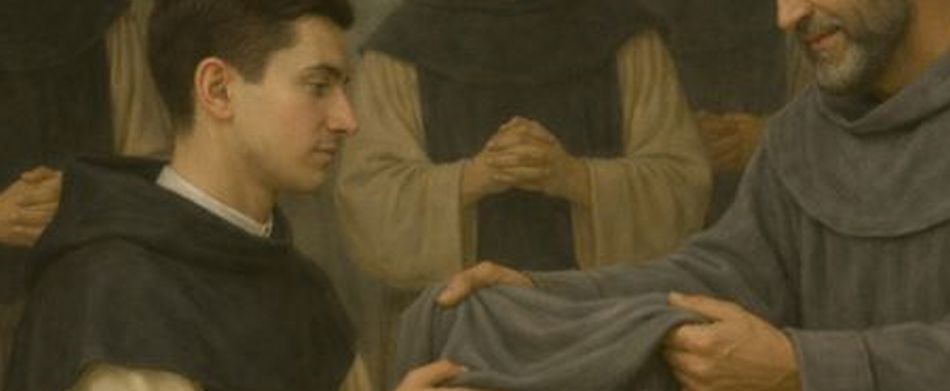
Fernando receiving the Franciscan habit
“WHAT’S in a name? That which we call a rose, by any other name would smell as sweet.” Thus muses Juliet Capulet in William Shakespeare’s play Romeo and Juliet (Act II, Scene II). Juliet is in love with Romeo Montague, but their families are feuding. To Juliet, when love leads, a name is insignificant.
However, names are often quite significant. Parents name their children for a variety of reasons:
- Honor or memorialize a friend, famous figure, parent or another relative.
- Place the child under the patronage of a saint whose name the child receives.
- Reflect a characteristic hoped for in their child (Beauty, Felicity, Joy, Victory).
- Share how the parent feels about the child (Theodore, Samuel, Matthew all mean “Gift from God”).
- Emphasize a physical characteristic of their child (Ebony, Scarlett, Raven, Pearl).
- Recall a meaningful place or object (Ocean, Bridges, London).
- A unique-sounding name (Neackana, Shambul).
Saint Anthony’s baptismal name was Fernando, a fairly common Portuguese name. When and why did Father Fernando de Bulhões become Father Anthony? Let’s imagine a possibility.
Giovanni Parenti
Squatting in the cucumber patch, Brother Gonçalo, guardian of the Franciscan Olivares hermitage outside Coimbra, was carefully pushing aside tangled vines and cutting from them firm, green fruit. This year’s extended harvest was plentiful. For a few weeks he had found enough cucumbers for his fellow friars, and for the poor as well.
Having already filled a basket, he was now sliding cucumbers into a second basket when a hoarse, nearby voice startled him. A servant in an olive-green belted shirt, brown leggings, and dusty shoes stood before him.
“Excuse me. Prior João from the Augustinian Monastery of Santa Cruz sent me with a message for the Guardian.”
“I am the Guardian.”
“Father Fernando has been granted permission to leave. Prior João requests that you accompany me to fetch him.”
Brother Gonçalo’s knees gave way, plopping him down amid the vines. He felt hot, weak, unable to control the throbbing in his heart. Some incredible work of God was unfolding here in a cucumber patch. Father Fernando had indeed requested admittance to the Lesser Brothers on the condition that he be sent to Morocco to preach the Gospel to the infidels. Gonçalo had agreed, certain that he’d never see this priest again. Either he’d change his mind or else his fellow monks would refuse to release him. Unless the Holy Spirit had willed it, Father Fernando could never have obtained the vote of every single monk to leave. In a cucumber patch, Gonçalo was living the aftermath of a miracle.
“Help me rise, please,” Gonçalo shakily asked.
Grasping the extended hand, Gonçalo felt himself pulled to his feet. “Can you support me?” He was stumbling over his words. “I need a traveling companion. We travel in pairs.” He pointed down the field to a hut. “There.”
The servant steadied Gonçalo to the visitor’s hut in which lodged Giovanni Parenti, the Provincial Minister who was making a visitation to Olivares. Since his authority surpassed Gonçalo’s, he should rightly be asked to be the traveling companion. Giovanni agreed.
After locating a spare tunic in the tailor’s hut, the three men started out, Gonçalo’s knees growing steadier as they neared Santa Cruz.
Unfolding miracle
The porter ringing the monastery bell.
Gonçalo and Giovanni ushered into a spacious, simply furnished room.
The canons filing in. Another. Another. Another.
Fernando approaching, kneeling. Giovanni raising him to his feet, helping him remove the monastery garb and replace it with the gray tunic.
Fernando embracing each monk, who then disappeared into the monastery until only Fernando remained.
Leaving behind his sandals, Fernando followed Giovanni and Gonçalo out of the room. The servant closed the door behind them.
Once off monastery grounds, Gonçalo introduced the older Giovanni to the youthful Fernando, who paused in his tracks at hearing that he had been clothed by the Provincial Minister.
Odd request
“Brother Giovanni, your being here is an answer to my prayers as I have a request. May I ask you to change my name?”
The odd request unnerved Gonçalo.
Giovanni’s answer came quickly. “Brother, some nuns and monks do this, in imitation of Simon whose name Our Lord changed to Peter, but the Lesser Brothers do not do this.”
“Nor did we at Santa Cruz.”
Fernando turned to Gonçalo. “Brother, does anyone besides yourself know that I am coming?”
“I never thought you would be. I have said nothing to anyone.”
“You know I have a reputation at Santa Cruz.”
“A very good reputation,” Gonçalo said.
“I humbly ask that, at Olivares, I be like the martyrs who spent their time in solitude and prayer before leaving for Morocco. Brothers, I seek humility. Saint Augustine said that humility is the root of all virtues. If the brothers know me by any name but Fernando, that would foster in me the growth of this virtue.”
Giovanni stroked his grey-flecked beard. “That is a commendable request. What do you think, Gonçalo?”
“I think that, if he has another name and anyone comes to us looking for Fr. Fernando, we could truthfully say, ‘There is no one here by that name.’ We have heard how many people came to visit him at Santa Cruz. Having continuous visitors here would disrupt our peace and solitude.”
Giovanni nodded. “Father Fernando, have you a name in mind?”
“Brother Giovanni, you are the Minister and Brother Gonçalo is the Guardian. It would be yours to select the name.”
“So, Gonçalo, I don’t know the names of the brothers here,” Giovanni acknowledged. “What do you suggest?”
Gonçalo’s mind raced through names. His mind was blank. Except for one name.
“The holy desert hermit Santo António of Egypt is the patron saint of Olivares.”
“He lived in the Egyptian desert. I think that extends into Morocco. Father Fernando, you have studied. You would know.”
“The Sahara Desert spans both Egypt and Morocco,” Fernando said.
“Brother António of…” Giovanni looked quizzically at Fernando. “Where are you from, Brother?’’
“Lisboa.”
“Brother António de Lisboa,” Giovanni pronounced. “What do you two think?”
Gonçalo was beaming.
António’s voice quivered. “I think that our Lord has spoken. Thank you.”
Meditation
In emails to the author, Jean Francois Godet-Calogeras, a scholar of early Franciscan history, wrote, “The change of name is an old tradition, already present in the Hebrew scriptures… It manifests a change of life. The practice developed in the Church from the early Middle Ages (6th century) for monks and nuns. It signified a break from secular identity to a new religious one… the first Franciscan generation did not adopt that practice… It is very clear that they [the early friars] kept their baptism name associated with either their parentage (father) or their place of origin. I do believe that Anthony is the one who changed his name to clearly state his change of life and religious spirituality.”
In Portugal, Saint Anthony is known as Santo António de Lisboa (Lisbon). Do you know why your name was chosen for you? Does your name have any meaning or significance? If you could choose your name, what would it be? Why?
Scripture says, “I have called you by your name; you are Mine” (Isaiah 43:1) Do you ever consider that God is calling you by name? What might He wish to say to you?
Updated on March 09 2026