


Foiled Martyrdom
May 11 2026
|
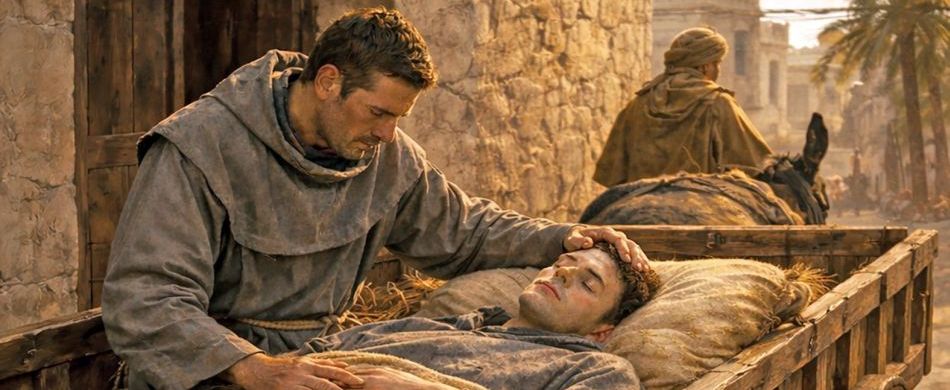
Anthony and Felipe, hidden on a cart, live a quiet white martyrdom, where suffering, sacrifice and love served a deeper witness than bloodshed
TO CATHOLICS, the word “martyr” conjures up images of people who died for the Catholic faith. The youngest martyrs are the Holy Innocents, whom Herod murdered in an attempt to slaughter the infant “King of the Jews.” One of the eldest martyrs is Bishop Saint Polycarp, who was martyred around the age of 85. Thousands of martyrs died for Jesus, some like Saint Maximilian Kolbe, in modern times.
In contrast to these “red martyrs,” who were killed for their faith, “white martyrs” are more numerous, but less recognized. Without being killed, white martyrs endure significant suffering, rejection, and sacrifice for their faith. White martyrdom follows from death of self through penance, moral integrity, adherence to the faith and service. White martyrdom lasts a lifetime.
Saint Anthony and two other friars hoped to become martyrs. All three succeeded, but in different ways. Let’s imagine how.
Brother Felipe dipped a length of white cloth into a basin of cool water, wrung it out, then replaced, with the cooler cloth, the too-warm cloth which draped Father António’s forehead. Then, with morning sunlight streaming through a high window opening, Felipe began the Terce, the mid-morning prayer.
Jasib, the leek vendor who had welcomed the three Lesser Brothers into his home, had predicted that António’s illness would last two weeks.
Jasib had been mistaken.
Felipe lowered his strong voice so that its tone matched António’s weakness. Back and forth, prayerfully, meditatively, they prayed the Psalms. Suddenly the door to the small room banged open.
Jasib stood in the doorway, his wide frame blocking the light. Never had he barged in during prayer.
“You are agitated, Honorable Jasib,” António wheezed. “Can we help with what troubles you?
Bad news
Jasib closed the door and began to pace the room. “How do I tell you? You have been no trouble here. You are quiet. You beg your own food. Well, Felipe does. Even my wife cannot complain. But now.” He paused and looked from Felipe to António.
“Word is in the streets that your friend has been killed.”
The news struck Felipe like a blow to his chest. Leão dead? Leão, Felipe, and António had sailed to Morocco to preach God’s word to the Saracens. They knew, even hoped, that they might die for Christ. When António suddenly fell ill, Felipe had stayed with him as a nurse while Leão had initiated the preaching mission. Leão had made the greatest sacrifice, dying for Christ. Felipe had lived with, traveled with, prayed with a martyr. The significance overwhelmed him.
Jasib was still pacing, his white thobe billowing about him with every step. Suddenly he stopped and faced them.
“You must leave.”
Before Felipe could protest, Jasib raised his palms upward to stop him. “People are angry. They say your friend spoke against our god, that our god was no god, but yours is. He would not recant. They killed him.”
“When?” António’s voice was weak.
“I don’t know.”
Leão had intended to preach on Good Friday. Easter and its octave had passed. So had two more weeks.
Jasib thrust his hand helplessly toward them. “When I brought you here because you were ill,” he gestured toward António, “I heard threatening words because I was harboring Christians. People complained. But I knew they would do no harm. Now people are furious. My wife is afraid. I cannot protect you. For your safety, for mine and my wife’s, you must leave.”
Jasib took a deep breath. “I have arranged for your passage on a ship bound for your Portugal. It leaves tomorrow. I will haul you there in my cart. Gather your things. You are leaving. Now.”
A different path
There were not many things to gather – prayer books, spare undergarments, little else.
Together, Felipe and Jasib supported António as he half-hobbled into the courtyard.
“We’ll lay him in the cart,” Jasib said. As António struggled to climb in, they heaved him up. He lay on his back, breathing heavily. Jasib shook his head. “I thought this was a stomach illness. You should be better by now. I don’t know what this sickness is. Perhaps doctors in Portugal will know.”
“Perhaps,” António smiled weakly.
“Brother Felipe,” Jasib said, “lie beside him. I’ll cover you with cabbages and artichokes.”
Felipe had never imagined they could feel so heavy. He lay still beneath the prickly leaves as the cart jerked forward.
“Are you alright?” he whispered.
“There are many ways to do penance,” António replied.
The journey to the docks felt endless. At last the cart stopped. Someone began moving the vegetables.
“Be still,” Jasib whispered. “I’ll find the captain.”
Then came shouts and rough laughter. Felipe dozed until the vegetables were pulled away.
“Up! Hurry before you’re noticed.”
Rough hands pulled them from the cart and rushed them up a gangplank into a fish-smelling vessel. They were quickly led into a dark hold. The hatch closed above them. António leaned against the swaying wall. Felipe eased him down and sat beside him.
“We never thanked him.”
“He knows,” António said. “Let’s pray for him.” He bowed his head. “May He who died for our sake make Jasib a partaker of His immortality.” His feeble voice faded beneath the sailors’ shouts.
After a moment, António fell silent. Alarmed, Felipe turned – but António only smiled faintly.
“So, Felipe, we go to Portugal, not to the Saracens.”
Felipe felt the weight of his lost dream. “I will never be a martyr.”
“You already are.”
“Are you delirious?”
“A martyr gives his life for Christ. You gave up your dream to stay with me.”
“I thought you would recover and that we would preach.”
“If you had known I wouldn’t recover, would you have stayed with me?”
Felipe hadn’t considered that. “Until someone else could care for you.”
“That is martyrdom, Felipe – a drab martyrdom, but martyrdom nevertheless.”
The ship lurched suddenly; a larger wave?
“Felipe, God has brought us here. Perhaps not for the Saracens, but for these sailors.”
Meditation
When António, Felipe, and Leão arrived in Morocco to preach to the Saracens, only Leão did so and was killed. Details are unclear regarding Felipe’s care of ill António, and how the two, either by their own choice or someone else’s, eventually boarded a ship to return to Portugal.
How was Felipe’s relinquishing of his dream a type of white martyrdom? Whom do you know who might be a white martyr? What qualifies them for this designation? Consider your life. Do you put others ahead of yourself? If not, might it be time to reverse the order? What would you have to change to strive for white martyrdom? Can you pray about doing that?
Updated on May 11 2026