


Life’s Intermissions
September 14 2026
|
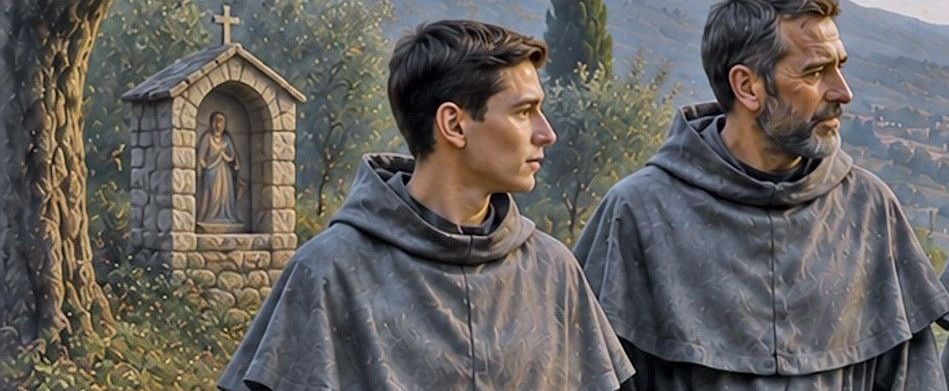
Anthony began his journey toward Assisi, unaware that God was leading him toward the mission that would change his life – and the lives of countless others – forever (AI Image)
AT A LIVE play or musical, the first part usually rises to a critical point, then the curtain closes, lights flicker on, and the audience takes a short break. To the audience, nothing much is happening, but not so backstage. Actors and dancers are changing costumes and getting hydrated. Stage managers are changing the backdrop and arranging the stage. The director is giving last-minute instructions to the cast. When all is ready backstage, the lights dim, the curtain opens, and the performance resumes.
Our lives have intermissions, too, when we are between one life drama and another. Sometimes the second drama is anticipated, such as when a person is preparing to begin college, a new job, or a marriage, or when a new baby is soon to be born. Other times, we don’t recognize a life intermission until it’s over and we’re thrust into a new scene.
Saint Anthony and Brother Felipe probably didn’t recognize a life intermission. Let’s imagine how that might have been.
Brother Felipe had been clutching the sides of the cart as it rumbled over the rough road leading from Capo Milazzo, where the ship had run aground, to Messina. The ship had been heading straight for Agrigento when, according to the captain, the wind changed direction and started to blow the vessel first northward and then east again. They must have been blown more than 1,000 miles off course, the captain said as he’d helped Felipe and Anthony into this cart. “We of the crew will stay in Capo Milazzo to try to repair the ship. It will take months. This cart will carry you to the hermitage of your monks. Maybe they can get you home.”
When the cart jolted to a halt, the driver pointed to a small wooden building. “This here’s Saint Ursula’s,” he said. “Wait in there. Them friars the captain’s sendin’ ya to – they take care o’ Saint Ursula’s. They’ll be comin’ ‘round.”
Saint Ursula’s Church
Grateful to have his feet on earth again, Felipe bounded out of the cart, then reached up to help Anthony down. They stood watching the farmer slap the reins and draw the ox cart away. Then the men walked into the church and knelt toward the back.
Felipe gazed at the wooden, boat-shaped tabernacle hanging above the altar. Everyone had heard of Saint Ursula, the virgin Christian princess who, with other virgins, sailed from Great Britain on pilgrimage. Pagans martyred all of them.
Ursula had died for Jesus. Anthony had said that Felipe was a martyr too, in a way, because he’d relinquished his own chance of martyrdom to care for sick Antônio.
Felipe had pondered that many times, and was pondering it again, when a black bearded brother dressed in a familiar gray tunic walked barefoot into the church. Stopping abruptly, he stared at Felipe and Anthony, then indicated that they should follow him outside.
The brother began to speak in an unfamiliar language to which Anthony answered in what Felipe recognized as Latin, the language of Holy Mass. The bearded brother replied in Latin, but Felipe didn’t understand much Latin.
Then the brother re-entered the church. Following after, Anthony whispered to Felipe, “To thank God.” Felipe was certainly thankful. He was alive, ashore, and with fellow followers of Francesco. How could he thank God enough?
Eventually, the unfamiliar brother rose, prostrated himself before the tabernacle and left the church. Anthony and Felipe prostrated themselves, then followed him.
“This is Father Enzo,” Anthony explained, introducing the friar. “He’s the guardian of the hermitage. He’ll teach us the language of this place. But first we need to accustom ourselves to our names here. Filippo and Antonio.”
Felipe nodded. Same names, slightly different accents.
Anthony and Enzo resumed walking and speaking with Felipe following. Every so often Anthony would turn to Felipe and interpret. In time, they arrived at a shallow stream.
“The hermitage is on the other side,” Anthony explained, stepping into the water.
With a surge of unanticipated joy, Felipe thrilled at the cool wetness rippling over his bare feet. Wading was a childhood joy. Gleeful memories rushed in. How right it felt to be here! How peaceful!
Across the stream lay a clearing dotted on the margins with poor huts like those at Olivares. In the center of the clearing, three brothers were weeding a tilled garden.
Under Enzo’s direction, the brothers, including Felipe and Anthony, hastily constructed two huts, one for Felipe and one for Anthony. After sharing a simple meal of begged loaves and artichoke, the six men prayed together and retired for the night.
Felipe had hardly lain back on his straw pile when his body and his consciousness melted into the scratchy softness. He awoke to a warbler’s song.
The Pentecost chapter
Serene days became weeks of sun and light and peace. Anthony grew stronger and was becoming fluent with the new language. Felipe was learning.
After dinner one evening, Fr. Enzo announced, “Brothers, remember, in three days, we will be leaving for the Pentecost Chapter in Assisi. We must prepare the hermitage for our return or for the new brothers who may come here.”
The Pentecost chapter? Felipe had never heard of it.
“Through our new Obediences, my brothers,” Enzo continued, “we will go where the Lord takes us.”
After the brothers were dismissed, Felipe drew Anthony aside. “Aren’t we returning to Coimbra?”
“It appears that we are going to Assisi. And from there, God knows where.”
“Do you think we’ll meet Father Francesco?”
“He’ll be there.”
“How will we get there?”
Anthony pointed to his bare feet and wiggled his toes. “With these.”
“Are you well enough to walk to Assisi? That’s far off.”
“I’m stronger now.”
Anthony was stronger. He’d been weeding and hoeing the garden. He, along with the brothers, had walked daily to Saint Ursula’s for Mass, which Anthony and Enzo offered on alternate days.
Three days melted away. A friendly fisherman offered to take the brothers across the narrow strait to the mainland where they began the trek to Assisi. The brothers slept wherever they stopped for the night – in a forest, under a bridge, in a church, in a grassy field. Along the way, they ate whatever they begged. In secluded streams and lakes they stripped, bathed, and washed their tunics and breeches. When someone requested confession, either Anthony or Enzo absolved them. Day succeeded peaceful day. After about a month the brothers entered a grassy plain jammed with rustic tables, hastily built hovels of woven mats, and more brothers than Felipe could imagine. They had reached the Pentecost Chapter in Assisi.
Meditation
After their ship ran aground near Messina, Sicily, Anthony and Felipe were taken to a Franciscan hermitage located in Messina, across a stream near Saint Ursula’s Church. There, the ill Anthony sufficiently recuperated and accompanied the other brothers to Assisi for the Pentecost Chapter.
Although Francis was not a priest, his spiritual sons respectfully called him “Father,” a term of relationship, not of priesthood.
Anthony and Felipe lived a “life intermission” in Messina. What life intermissions have you had? During them, did you feel the peace that Felipe describes? Were these intermissions calm intervals that prepared you for greater works to follow?
Updated on July 30 2026