



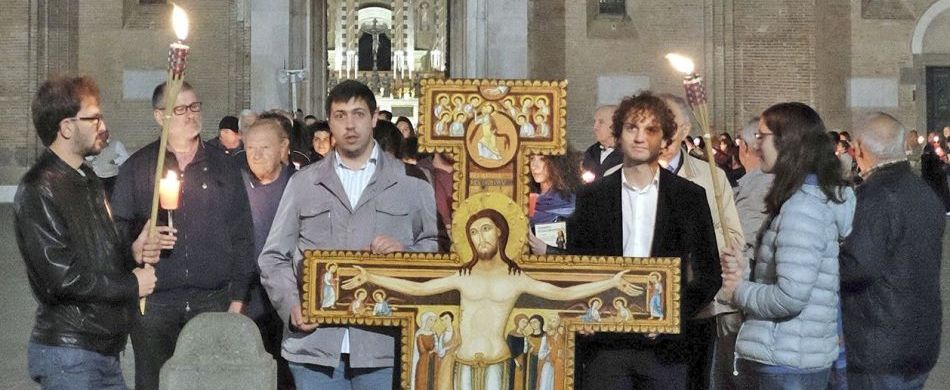
A moment during the celebration of the Transitus in the Basilica of St. Anthony
Dear Friend,
Every year, on the evening of October 3, we friars gather with many of the faithful in the Basilica of Saint Anthony to celebrate the Transitus of Saint Francis: his passage from this life into eternity. The same thing will happen in churches large and small throughout the world, as we gather in spirit around the Poor Man of Assisi.
You may be wondering: why is the Transitus celebrated on October 3 if the feast of Saint Francis is on October 4?
The answer is simple. Francis died on the evening of October 3, 1226, lying on the bare ground near the Porziuncola. By sunset, however, the liturgy had already moved into the following day. That is why we remember his Transitus on October 3 and celebrate his feast on October 4.
This is perhaps the only small misunderstanding we can have today about Francis. His life was remarkably clear and allowed no compromise with the Gospel. When God became the center of his life, Francis stripped himself even of his clothes before the bishop, his father Pietro di Bernardone, and the people of Assisi. It was not an act of rebellion, but a declaration of love. From then on, he would have only one Father: his Father in heaven.
Soon afterwards, reading the Gospel in which Jesus sends his disciples out to preach without money or possessions, Francis knew he had found the path he was seeking. “This is what I want, this is what I seek, this is what I desire with all my heart!” he exclaimed. And that is what he did.
When others, inspired by his example, began to join him, Francis did not want the new fraternity to become his personal project. He travelled to Rome to seek Pope Innocent III’s approval for their way of life. He wanted to follow the Gospel within the heart of the Church.
Throughout his life, we find the same pattern: whenever Francis understood what God was asking of him, he responded generously – without excuses, delay, or watering down the Word of the Lord. And what about us?
There could easily be a far more serious gap than the one between October 3 and 4: the distance between the Gospel we hear and the Gospel we live. How often do we confuse what the Gospel asks with what suits us? When Jesus challenges us, we often soften his words so that they demand less. Instead of allowing the Gospel to change our lives, we risk adapting it to the life we have chosen.
Francis shows us another way: not heroism reserved for a chosen few, but the path of trust. He reminds us that true joy begins when we stop placing ourselves at the center and make room for the Lord.
Perhaps this is why, eight hundred years after his death, Francis still fascinates people of every age, culture and religion. His life is the Gospel translated into action. And the Gospel, when truly lived, never grows old. After eight hundred years, Francis still speaks. He speaks to you and to me. He speaks to all of us.
The Transitus we celebrate this October 3 will not simply recall an event that occurred eight centuries ago. It will invite us to look honestly at our lives and ask what still prevents us from following the Lord wholeheartedly.
May this eighth centenary of Saint Francis’ death be an opportunity for us all to begin again with the simplicity of the Gospel.
I wish you a happy and blessed feast of Saint Francis. May his example of peace, fraternity and love for the Lord light your path each day.
With affection and closeness in prayer,
Friar Mario
Updated on September 30 2026