


The Unknown Friar
October 12 2026
|
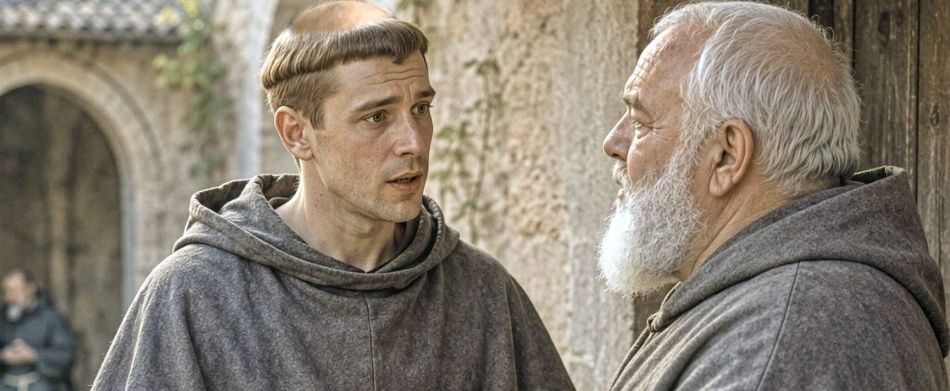
Anthony speaks with Friar Gratian, Provincial of Romagna, who welcomed the unknown friar and gave him a place in his province
EVERY action has a motive. The motive can be any number of things; to support a family, to gain college admission, to qualify for a better job, to grow closer to our Lord. Sometimes we’re confused about our motive. We may think that we’re trying to get good grades to enter college, but actually we’re striving to please our parents. We may deceive ourselves by thinking that our involvement in parish activities is a way to grow spiritually, but actually we anticipate these events as comfortable ways to socialize.
Proverbs 16:2 notes, “All a person’s ways seem pure to them, but motives are weighed by the Lord.” Jesus reminded his listeners of this in words we hear during Lent, “Be careful not to practice your righteousness in front of others to be seen by them. If you do, you will have no reward from your Father in heaven” (Matthew 6:1).
In the wake of his failed trip to Morocco, Saint Anthony seems to have examined his spiritual motives. This led to a definitive change. Let’s imagine how this may have come about.
Father Gratian smoothed his black beard, took a last look at the wattle hut in which he’d been sleeping, and heaved a sigh of completion.
Whew! This amazing Pentecost Chapter was over, four days late because, at Father Francis’ insistence, the brothers stayed until they’d consumed the massive amount of food brought by the people of Assisi. The heavily laden tables were finally empty, and women, some exquisitely dressed, were scrubbing them clean.
Just an hour ago, Cardinal Ugolino had mounted the platform, now being dismantled, to bless all the brothers and bid them farewell. The brothers bound for the Romagna province were clustered around Gratian, who began to name and count them before starting out.
Over a week ago, Gratian and the Romagna contingent had approached Assisi. They’d been caught in a throng of gray robed brothers mingled with laity on festooned palfreys, all heading in one direction, the plain of Assisi. The scene on the vast, grassy plain was like a fair swarming with religious and laity. In record time, three men in tunics had approached Gratian and led him and his brothers past innumerable tables, benches, and huts to an open area where other men were weaving additional lattice huts and covering them with reed mats for the Romagna contingent.
Fifty-two friars
One, two, three… Gratian began to count the brothers who would return with him to the cities he knew well: Cesena, Forlì, Ravenna, Faenza, Imola, Rimini. Ten, eleven, twelve…
As the brothers stood among their huts on the matted grass, two men in tunics appeared, and began cracking the daub, removing the mats, and dismantling the lattice work. To the far left, other men were dismantling the platform on which Father Francis and Brother Elias, the Vicar General, had spoken. Francis had sat at Elias’ feet, tugging at the hem of the Vicar General’s robe whenever he wanted to talk. When Elias granted permission, Francis would address the brothers. His message was always straightforward but profound: repent, revere the Eucharist, honor priests, pray unceasingly, guard chastity. Thirty, thirty-one, thirty-two…
Right now, near the Portiuncula chapel, a conspicuous, red-bearded brother from Germany had gathered his contingent. Gratian could see that he, too, was counting. God willing, this second contingent would be more successful than the first missionary contingent whom the Germans had driven out.
Fifty-two; that was the number assigned to Brother Gratian.
A pale brother
“Brothers…” Gratian began to speak when a young brother who was not in the contingent sprinted toward him.
“Excuse me, Brother. You are a Provincial?”
The eager-faced young man was stumbling over the words. This was not his native language. Was that an accent from Hispania? Gratian thought and then answered in Latin, “I am a Provincial.”
The youth looked confused. Gratian switched to the language of the locals. The brother still shook his head. He raised his hand in a gesture that indicated that Gratian should wait, then turned and darted away. Gratian shrugged.
Speaking slowly and simply in Latin, Gratian began again to speak to his group. Hopefully each brother would understand enough. In time, those who didn’t know Latin would learn. Simply, he explained that they’d start off as a group and then split to go to the hermitages in the towns and cities. He began to tell them about the major cities when the eager, language-impaired brother returned with a companion, a pale brother with a sallow complexion and sunken cheeks.
The sickly brother began to speak in Latin, “Excuse me. Brother Felipe of Castile is concerned that I have not yet received an obedience, that is, an assignment. He wants me to ask you to take me into your province.”
Gratian quickly evaluated the unimpressive pale man. “You speak Latin. Are you a priest?”
“As you must also be.”
Gratian nodded. “Indeed. I am Father Gratian from the Romagna. And you?”
“Father Anthony of Lisbon.”
Lisbon. A long way off. And not the language known to the people of the Romagna region, Father Gratian thought to himself. Then he replied, “All the hermitages in the cities already have priests.” Montepaolo, the thought flashed in Father Gratian’s head. The brothers at Monte Paolo had asked for a priest. Many times. Their hermitage was perched high in the Apennine Mountains, a four-hour walk from Forlì. Every Sunday, the brothers descended the slope to Forlì for Mass, then trudged back up, exhausted by the time they returned. They could save themselves the trek if they had a priest. But why isolate a priest in Montepaolo when he could serve more people in the cities? Could this priest even make it to Montepaolo?
“Father Anthony, it took us over a week to arrive here from the Romagna.”
Anthony nodded. “It took us over three weeks to walk here from Messina.”
“You must have ridden.”
Anthony grinned. “Walked. Stumbled sometimes.”
Gratian chuckled. “What are you seeking, Father?”
“To learn the basics of the spiritual life. Obedience. Prayer. Surrender.”
A priest, and he has not already mastered these virtues? Gratian thought. Nevertheless, the sickly brother seemed sincere. “Would you be willing to live in a mountain hermitage and offer Mass for the brothers?”
“Certainly. I will do whatever you tell me.”
“Then, if Brother Elias agrees, you are welcome in the Romagna.” Within the hour, the Vicar General had agreed.
At the time of the Portiuncula Chapter in 1221, the people of Assisi revered Francis. Joyfully, they brought food and served the massive number of friars.
Although Francis was an ordained deacon, not a priest, the brothers called him Father Francis out of respect.
After consulting with the Provincials, Brother Elias assigned the brothers their respective assignments (obediences) in specific friaries. The early sources tell us that either Brother Felipe or Anthony or both approached Father Gratian, the Provincial of the Romagna, about taking Anthony. Brother Elias consented.
Meditation
Perhaps Anthony was beginning to understand that even our noblest desires need to be placed in God’s hands. Wanting to serve God is not always the same as allowing God to lead us. Sometimes our plans must fail before we are ready to follow a path we did not choose. Anthony accepted that hidden path, and it changed his life.
Are you being honest with yourself? What are the real motives for your actions? Do they indicate that any change is needed?
Updated on September 29 2026