


There is a martyrdom hidden in ordinary life... (AI Image)
Dear Friend,
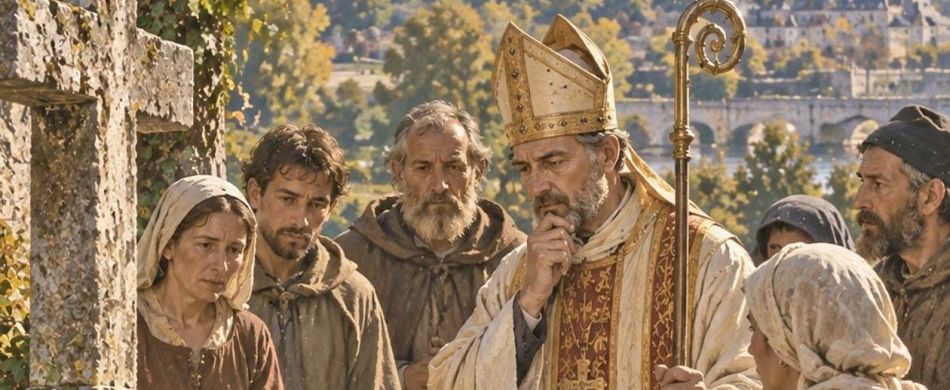
There was a place not far from Tours, in west-central France, where people used to gather to pray at the tomb of a man believed to be a martyr. An altar had been erected there, and for years no one had questioned the tradition. No one, that is, except Martin.
Martin, Bishop of Tours, wanted to know more. Who was this martyr? When had he died? What had happened to him? Nobody could give him a clear answer. So, Martin did something simple: he refused to pretend that he knew what he did not know.
According to Sulpicius Severus, Martin’s contemporary and biographer, the bishop went to the tomb with a few companions and prayed for the truth to be revealed. Martin learned that the man buried there was no martyr at all, but a criminal executed for his crimes. He immediately ordered the altar removed.
This is one of the lesser-known stories about Saint Martin. Much more familiar is the account of him as a young soldier cutting his cloak in two to share it with a freezing beggar. But I like this other story because it tells us something important about Martin: he loved the truth. Even when people had believed something for years, even when a tradition had become popular, he was not afraid to ask questions.
There is also a wonderful irony in this story. Martin was careful about calling another man a martyr, yet after his death he would become one of the greatest saints of Christianity, but without ever shedding his own blood.
This was significant in the early Church. For centuries, Christians had looked above all to the martyrs as examples of holiness: men and women who remained faithful to Christ even when it cost them their lives. Their blood had become the most powerful testimony to their faith.
However, the age of the great persecutions eventually came to an end. Christians began to understand more clearly that there was another way of bearing witness to Christ: offering one’s whole life to God. People like Martin were called confessors. They had not shed their blood for Christ, but they had confessed him through the way they lived. And Martin did this wonderfully. He had been a soldier, then a monk, and finally a bishop. Yet through all these changes he remained essentially the same man: simple, prayerful, close to the poor and unwilling to place himself above others.
Perhaps that is why people loved him so much. They saw holiness not in someone who had performed one extraordinarily heroic act, but in someone who tried to belong to Christ every day. And every year on November 11, his feast day, the Church invites us to remember this faithful and deeply human way of following Christ.
Most of us will never be asked to die for our faith. Hopefully, we will never face a dramatic moment in which we must choose between Christ and our own life. But every morning we are given another choice: we can give a little of our time to someone who needs us; we can forgive instead of holding a grudge; we can tell the truth when a lie would be easier; we can notice the person everyone else ignores; we can share not only our possessions, like Martin shared his cloak, but also our patience, attention and kindness.
There is a martyrdom hidden in ordinary life: the quiet dying to selfishness that allows love to grow. Saint Martin reminds us that holiness does not always need a dramatic ending. Sometimes it simply needs a faithful life.
Perhaps the greatest gift we can offer God is not to give our life in one heroic moment, but to give it to Him little by little, lovingly, every day.
Updated on October 30 2026