Doing Better
September 21 2026
|
The hope of doing better has become a reality
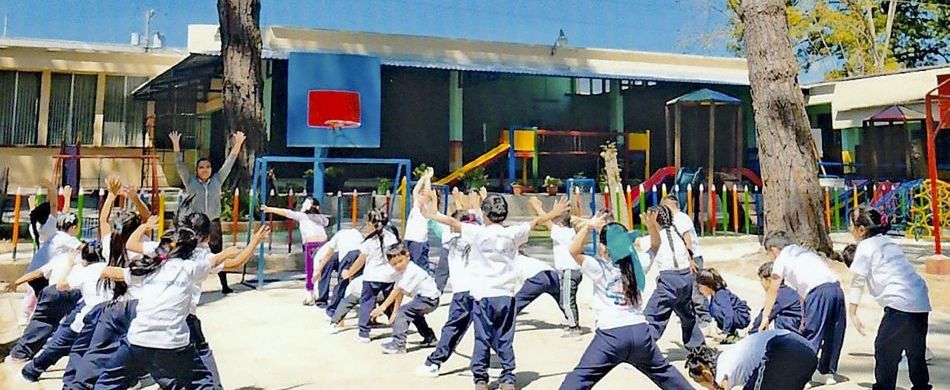
THE PLAY area floor at the Centro Educativo para Párvulos Sagrado Corazón de Jesús – the Sacred Heart of Jesus Early Childhood Education Centre – in Mixco, Guatemala, had been breaking apart for years. Cracked and uneven, it had become a daily hazard for the four-, five- and six-year-olds who ran across it. Inside, the false ceiling panels in the classrooms and corridor had deteriorated to the point where some hung loose, at risk of falling on the children below. When the rainy season arrived, water poured into the open-sided activity hall. And for any child arriving in a wheelchair, the building was simply inaccessible – steps at every entrance, not a ramp in sight. The school, which had been serving the poorest families of Colonia San Ignacio for over three decades, was long overdue for urgent repairs.
“With the passing of time the building had been deteriorating,” says Sister Maria Teresa Muralles Reyes, Economic Administrator of the Education Centre. “We saw the urgent need to redo the recreational area – all the cement-covered ground needed to be replaced. We also needed to remodel the entrance, since there was no ramp to access the classrooms and bathrooms, to facilitate the mobility of children in wheelchairs.”
Red zone
The school belongs to the Handmaids of the Sacred Heart of Jesus under the Protection of Saint Joseph. The congregation was founded in Imola, northern Italy, in 1876 by Sister Lucia Noiret, a nun of Savoyard origin whose vision for the education of the poor became the foundation of an international mission. Their General House is in Bologna, and today the congregation carries its educational work to communities in Italy, Guatemala, Mexico, and El Salvador. In 1990, the Sisters founded the school, beginning with six children gathered in the hall of the Church of Santa Cecilia. By the following year, with the support of Italian and Guatemalan benefactors, a dedicated building had been completed. On 14 February 1991, it was inaugurated and blessed. Today, the school serves 115 children in preschool, pre-kindergarten, and kindergarten programs, housed in three classrooms, each designed to accommodate up to 50 students.
The neighborhood in which the school sits is classified as a “zona roja” – a red zone – due to violence, extortion, and drug activity. Internal migration driven by poverty, unemployment, and family breakdown is constant. Many children come from single-parent households. Many of their mothers work informally at home, subject to the extortion payments that are a daily reality in the zone. School fees are set at half the rate authorized by the Ministry of Education, because most families live in extreme poverty – but they are barely enough to cover teachers’ salaries. The COVID-19 pandemic deepened an already precarious situation, and for many of the 115 children and their families who depend on it, the school is also a refuge.
Three priorities
The Sisters drew up a formal project proposal to St. Anthony’s Charities titled La Esperanza de Mejorar – The Hope of Doing Better. It identified three urgent priorities: renewing the play area floor, constructing access ramps for children with disabilities, and repairing and extending the roof. Sister Julieta Oliva Reyes, Regional Delegate for Latin America, wrote in support, noting that investing in early childhood in Guatemala had become a matter of urgency, particularly in the wake of COVID-19 and the extortion that afflicts even the smallest businesses, driving parents to keep children at home rather than face the cost of schooling. Sister Eulalia Calderón Alcántara, Superior General of the congregation, was equally direct: “Without the support of benefactors,” she wrote, “it would be impossible to keep the school standing.” St. Anthony’s Charities approved a grant of €11,000, to be disbursed in two instalments.
Work began on 23 December 2025, deliberately timed to use the school’s Christmas closure. But the Guatemalan school year starts with pupils in classrooms on 15 January, which left barely three weeks to complete a substantial construction program. There was a further complication: the first instalment of funding could not be withdrawn from the bank until 13 January 2026 – weeks after work had begun and the school term was already under way. “We are not experts in project administration,” says Sr. Maria, “and we found it difficult to send the required data, which caused a delay in receiving the money. We found ourselves needing to take out a loan to cover the costs.”
Despite everything, the work was finished on 6 February 2026. Internal and external ramps were constructed at the main entrance and along the 16-metre approach to the kindergarten classroom, each fitted with safety railings. Three removable ramps were installed at the bathrooms and main entrance. Sixty-three meters of canopy were fixed to the open activity hall, ending the annual flooding. The broken play area floor was levelled, compacted, and re-laid with 83 square meters of new concrete. Three hundred and seventy-eight false ceiling panels were replaced with fresh white fiber-cement boards, new corridor lighting was installed, and the corridors and administration office were repainted. The congregation covered a small additional amount beyond the grant to complete the works, bringing the total invested to just over €11,000.
Inclusive school
For the children who arrive in wheelchairs or with limited mobility, the ramps represent more than a practical convenience. “As an educational center we are called to favor the inclusion of children with diverse abilities,” says Sr. Maria. “The ramp is there because there are many steps, and we want to facilitate access to classrooms and bathrooms for children who attend the school with diverse abilities.” The renewed ceiling and safe, even ground underfoot have transformed the daily environment for every child in the building.
“We thank St. Anthony’s Charities and the readers of the Messenger of Saint Anthony for your invaluable collaboration and generosity,” says Sr. Maria on behalf of the whole community. For 115 children in one of Guatemala City’s most overlooked neighborhoods, it has made all the difference. The hope of doing better has become a reality.
Updated on July 30 2026