
Heart Project
March 23 2026
|
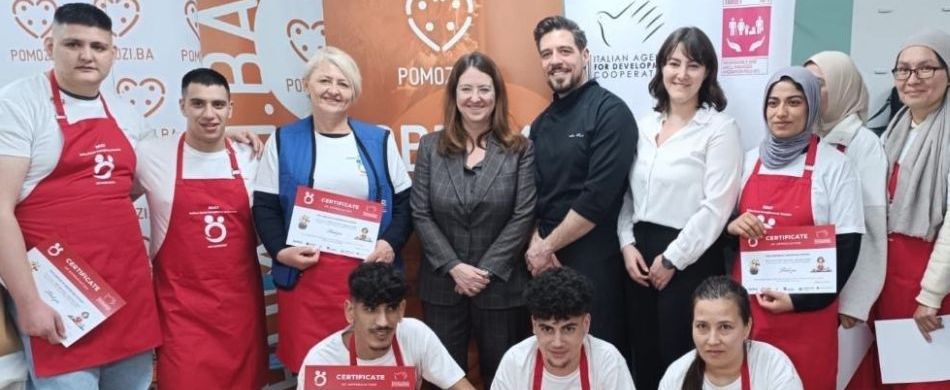
Participants receive their certificate at the end of the cookery course
IN THE RECEPTION centers of Sarajevo and the Una-Sana Canton in northwestern Bosnia-Herzegovina, thousands of migrants and refugees face a daily struggle. Many have endured trauma on dangerous journeys from Afghanistan, Morocco, and Syria. Most of the migrants are young, and unaccompanied minors comprise up to 15 percent of arrivals, vulnerable to exploitation in all its forms. For these people in transit, access to basic healthcare, psychological support, and a sense of community can mean the difference between despair and hope. It was to address these urgent needs that the Jesuit Refugee Service (JRS) launched the HEART project – Helping Everyone Achieve Resilience Together – under the leadership of Father Stanko Perica, SJ, regional director of JRS south-east Europe.
Key waypoint
Since 2018, Bosnia-Herzegovina has been a key waypoint on the Balkan migration route toward Western Europe. Between 2018 and 2023, approximately 117,800 migrants arrived and passed through the country. By mid-2024, around 1,800 remained registered on Bosnian territory, most housed in temporary reception centers. “Many of the migrants have suffered significant trauma and require psychological support,” Fr. Stanko explains. “Additionally, since the camps provide only basic medical care, there is need for further medical assistance, including eyeglasses and dental services.”
JRS first began operations in Bosnia-Herzegovina in 1994, focusing on assistance to war refugees during the Balkan conflicts. The Sarajevo office remained active until 1998, and reopened in 2018 in response to the new waves of migrants. From 2018 onward, JRS has been active in all major reception centers, offering translation services and organizing cultural and creative workshops. In June 2023, with support from St. Anthony’s Charities, JRS opened a dedicated reception center for unaccompanied minors in partnership with the Ministry of Security and the Social Service Center.
The HEART project set out to provide comprehensive support to vulnerable groups through medical assistance, psychological and psychosocial care, educational programs, and social integration activities. The project would operate across four reception centers: Ušivak and Blažuj near Sarajevo, and Borići and Lipa in the Una-Sana Canton, as well as at JRS’s own center for unaccompanied minors in Sarajevo and the JRS day center in Bihać. The total project budget was €100,000, with JRS contributing €50,000, other partners providing €15,000, and St. Anthony’s Charities approving a grant of €35,000. The funds would cover staff salaries for a project coordinator, psychologist, and cultural mediator; medical and psychosocial materials; educational programs; and the purchase of a vehicle to facilitate outreach and transport beneficiaries to medical appointments.
Three phases
The project launched in October 2024 and unfolded across three phases over 11 months. During the first phase from October to December 2024, JRS provided essential services to 2,863 beneficiaries. Medical assistance included eye examinations and glasses, dental care, orthopedic treatment, and medication for minors with various health needs. Psychological support reached 163 beneficiaries through individual counselling sessions, while 1,211 people participated in group workshops addressing trauma, anxiety, stress management, and emotional resilience. “These workshops contributed to a significant improvement in the mental health of beneficiaries,” says Fr. Stanko. “Many of them spoke openly about their problems for the first time, showing the first signs of returning to a sense of security and control over their lives.” Social activities brought migrants together with local communities during the Christmas season, while the day center in Bihać welcomed an average of 30 visitors daily. Five beneficiaries began a 25-week IT and graphic design course.
Challenges emerged early. “One of the main problems was finding participants who could guarantee consistent presence in planned activities, since many had plans to leave and could not commit long-term,” Fr. Stanko explains. Winter conditions made access to Lipa camp particularly difficult, and medical treatments often went incomplete because beneficiaries departed before prescriptions were filled or glasses ready. To adapt, JRS adjusted activity schedules, organized alternative transport routes, and established faster communication with medical facilities.
From January through April 2025, services continued and intensified, reaching 2,720 beneficiaries. Medical care, psychological support, and educational activities all expanded. Language courses were offered in Bosnian, English, and German, while IT literacy classes introduced beneficiaries to Microsoft Office and design tools. The vehicle purchased during this phase significantly improved transport logistics. Social integration activities multiplied: iftar meals during Ramadan, Easter celebrations, school visits, and sports events brought migrants and locals together. A cooking course at Ušivak camp graduated its first participants. “Through this collaborative experience, participants shared culinary skills, exchanged cultural traditions, and built connections with local residents,” says Fr. Stanko.
The final phase from May through August 2025 served 1,990 beneficiaries. Medical services continued, while psychological support became particularly crucial. During this period, psychological services were transferred to a state-run mental health center which had limited capacity to meet all beneficiaries’ needs, so JRS’s psychologist ensured continuity of care for 268 beneficiaries through individual counselling and group sessions. Educational programs expanded to include job skills training, CV writing, and interview techniques. Seven beneficiaries enrolled in a month-long auto mechanics training program at a local repair shop, while two attended formal Bosnian language courses. Social activities included a three-day integration camp for International Youth Day, visits to a national park, swimming sessions, and film screenings.
Beyond numbers
By project completion in August 2025, approximately 7,600 people had benefited from the HEART initiative across the three phases. The results extended beyond numbers. Families accessed healthcare that would otherwise have been unavailable. Children and young people learned skills opening pathways to employment. Isolated individuals found community. “The project promoted with success an approach centered on the person and respectful of dignity, addressing the specific needs of each individual and contributing to creating a safer and more supportive environment for people in movement in Bosnia-Herzegovina,” concludes Fr. Stanko.
Fr. Stanko and the JRS team offer their heartfelt thanks to St. Anthony’s Charities and to the readers of the Messenger of Saint Anthony whose generosity has brought hope to people far from home.
Updated on March 23 2026