

New Life in Chad
January 26 2026
|
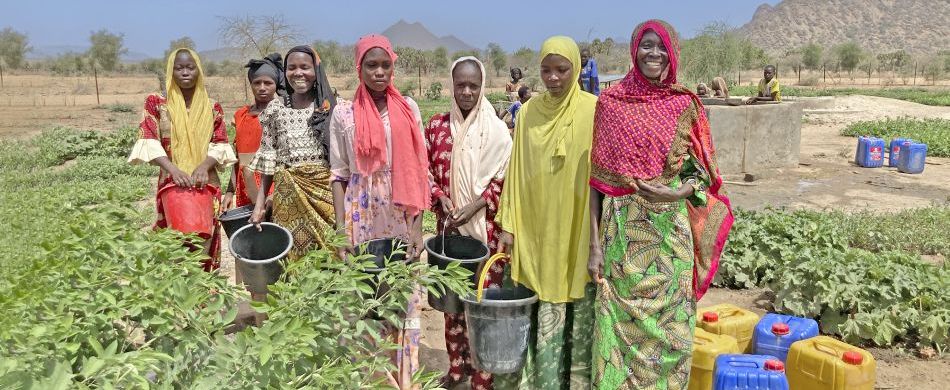
In Chad’s Guéra province women had to walk 6 kilometers to neighboring Baro for a bucket of water
IN THE DRY season wells in Mabar, in Chad’s Guéra province, often ran dry. The women had to walk 6 kilometers to neighboring Baro for a bucket of water to be used for cooking, cleaning, and drinking. There were no vegetable gardens; families sold sorghum or sesame to buy vegetables when they could. Thanks to support from St. Anthony’s Charities and local partners, that reality has changed.
This successful project was organized by the Fédération des Banques des Céréales du Guéra (FBCG – the Federation of Cereal Banks of Guéra), a social-pastoral instrument of the Diocese of Mongo, under the presidency of Father Franco Martollozzo. Cereal banks are community-run reserves that keep staple grains – especially sorghum – available locally during the lean season to help households stabilize their food access.
“The province of Guéra is part of the great Sahelian belt where climatic hazards negatively affect the agro-pastoral activities of the population,” explains Fr. Franco. “Agro-pastoral production is strictly limited by these climatic hazards.” Against that backdrop, market gardening women’s groups were formed with a focus on home consumption and local sales. But many of the groups still lacked one essential ingredient: reliable water.
€20,000 granted
The project set out to make four gardening sites operational with water and irrigation – Baro Kadar, Mabar Dibi, Gourbiti Tondo, and Gourbiti Alpha. Baro and Mabar required new boreholes; Gourbiti’s two sites already had boreholes and needed only equipment. The plan covered a geophysical study at Baro and Mabar to confirm groundwater, specialist rotary drilling suited to hard granite, the installation of four solar-powered pumps, four elevated storage tanks of roughly five cubic meters, and an irrigation network of pipes and valves to carry water across the plots.
The initial budget was €31,600, with a €1,000 local contribution and €10,600 from other benefactors. St. Anthony’s Charities agreed a €20,000 grant. Final realized costs came to €27,000, financed by €20,000 from St. Anthony’s Charities and the remainder from other sources.
Implementation unfolded in two linked phases. The first tranche of funds, €10,000, arrived in February 2025, and on April 22 drilling work at Baro Kadar began. A 43-metre borehole was completed in one day with PVC casing and screened sections across three water-bearing fractures; the tested flow was two cubic meters. The team began early the next day at Mabar Dibi, completing the 44-meter borehole similarly equipped; the tested flow was three cubic meters.
Once the balance of funds was released, the second phase equipped all four sites: solar pumps at each site together with a raised five cubic meter tank on a steel stand and a distribution network of pipes and shutoff valves. Completion was recorded on May 30, 2025. Thankfully, no difficulties were reported during the project.
Successful project
The results are visible in households and on the market garden plots. In Gourbiti Tondo, where women once relied on a hand pump and harvested little, the switch to solar power expanded area and variety. Fatimé Tari, president of the Tondo group, says, “We only had a borehole before, but with the hand pump we couldn’t produce much. This year with the solar pump we have increased and diversified our production. The harvest that we sold brought 126,000 CFA (Central African Francs). We say a big thank you to the whole team.”
In Baro, the new system now provides irrigation and safe household water, reducing the risk of water-borne disease. In Mabar, a site for gardening did not exist before; the new borehole, solar pump, and tank created the village’s first productive garden. Khadidja, president of the women’s group in Mabar, explains the change and offers thanks: “We didn’t even have water to drink; in April and May we sometimes had to go to Baro, 6 kilometers away. The wells would dry up. We could never create gardens. We used to sell our cereals or sesame to buy vegetables. Today, our garden allows us to contribute to the families’ nutritional needs. We sell the surplus of the produce, and with the money we buy notebooks and enroll our children in school. May God bless all who contributed to this project.”
Unity reinforced
The reach is substantial. There are 198 women direct beneficiaries with 1,386 indirect beneficiaries in their households and nearby families. With irrigation in place, the women have been able to save staple crops from the rainy season and strengthen family diets through dry-season vegetables. Income from surplus sales has covered school supplies and fees.
There is a social dimension as well. The work has reinforced unity and collaboration as the women manage shared infrastructure and coordinate planting and watering schedules. Environmental benefits are also starting to appear. The project has “created a micro-climate in the village because having water next to the gardens ‘softens’ the climate,” says FBCG secretary, Madas Allamine. Additionally, the communities have begun small tree nurseries to support local reforestation.
Local participation from the beginning has helped make the systems sustainable. Parish-linked associations led awareness and training on using and maintaining the irrigation equipment, and members raised funds toward the local contribution. Because the gardens are organized as women’s groups that produce and sell, each site now functions as a small economic unit with its own momentum – water is the key that has unlocked that capacity.
In 2015, Pope Francis wrote, “Access to safe drinkable water is a basic and universal human right” (Laudato Sì, §30). In Chad’s Guéra province, the new boreholes and solar pumps honor that right. The women and families there offer their heartfelt thanks to St. Anthony’s Charities and to readers of the Messenger of Saint Anthony, whose generosity has helped bring this project to life.
Updated on January 27 2026